
The Ultimate Guide to Dog Nutrition: How Much Should You REALLY Feed Your Dog?
The truth is, the “one-size-fits-all” approach to canine nutrition is a myth. Feeding your dog isn’t just about satisfying their hunger; it’s about fueling their biology, maintaining their metabolic health, and ultimately, extending their lifespan. When you ask, “How much should I really feed my dog?” you aren’t just asking for a measurement—you’re asking for a roadmap to your pet’s long-term wellness.
In this comprehensive guide, we will dive deep into the science of canine caloric needs, the hidden traps in commercial dog food labels, and the step-by-step process to determine the perfect portion for your unique furry friend.
The Great Dog Food Dilemma: Why One Size Does Not Fit All
Every dog is a unique biological entity. A 50-pound Border Collie who spends six hours a day herding sheep has vastly different nutritional requirements than a 50-pound Basset Hound who spends six hours a day napping on a velvet sofa.
The feeding guidelines found on the back of dog food bags are often based on “average” dogs, and these averages can be misleading. Manufacturers frequently overestimate the calories a dog needs to ensure they don’t get blamed for a dog being underweight. Furthermore, these charts usually don’t account for:
- Metabolic rate: Just like humans, some dogs have “fast” metabolisms while others gain weight just by looking at a treat.
- Spay/Neuter status: Altered dogs typically require 20-30% fewer calories than intact dogs due to hormonal changes.
- Environmental temperature: Dogs living in cold climates burn more calories just to stay warm.
- Life stage: A growing puppy needs a calorie-dense diet, while a senior dog might need fewer calories but higher-quality protein.
To get the portion size right, we have to move past the bag’s instructions and look at the science.
Understanding Your Dog’s Caloric Needs: The Science of RER and MER
Veterinary nutritionists use two primary metrics to determine how much a dog should eat: Resting Energy Requirement (RER) and Maintenance Energy Requirement (MER).
1. Resting Energy Requirement (RER)
RER is the energy needed to perform essential body functions such as digestion, respiration, and heart function while at rest. Think of this as the “baseline” calories your dog burns just by existing.
The standard formula for RER is:
RER = 70 × (body weight in kg)^0.75
For a simpler, “quick-and-dirty” estimate for dogs between 5lb and 45lb:
RER = (30 × body weight in kg) + 70
2. Maintenance Energy Requirement (MER)
Once you have the RER, you must multiply it by a factor that accounts for the dog’s lifestyle and life stage. This is the MER.
- Neutered Adult (Average Activity): 1.6 x RER
- Intact Adult (Average Activity): 1.8 x RER
- Active/Working Dog: 2.0 to 5.0 x RER
- Weight Loss: 1.0 to 1.2 x RER
- Senior Dog: 1.2 to 1.4 x RER
- Puppy (under 4 months): 3.0 x RER
Example Calculation: If you have a 20kg (44lb) neutered adult dog:
- RER = 70 × (20)^0.75 ≈ 660 calories.
- MER = 660 × 1.6 = 1,056 calories per day.
Decoding the Dog Food Label: What Those Numbers Actually Mean
Now that you know your dog needs, say, 1,000 calories a day, how do you translate that into “cups”? This is where many owners get tripped up.
The “kcal/kg” vs. “kcal/cup” Confusion
The Association of American Feed Control Officials (AAFCO) requires manufacturers to list the calorie content of their food. Look for the “Calorie Content” statement on the label. It is usually expressed as kcal/kg (kilocalories per kilogram) and kcal/cup.
The problem? “Cup” is not a universal measurement in the dog food world. One brand’s cup might contain 300 calories, while another’s grain-free, high-protein formula might contain 550 calories. If you switch brands and keep using the same scoop without checking the label, you could inadvertently increase your dog’s caloric intake by 80%!
The Ingredient Quality Factor
A calorie is not just a calorie. A 400-calorie meal consisting of high-quality animal proteins and healthy fats will be processed differently by your dog’s body than a 400-calorie meal loaded with corn, soy, and fillers. High-quality foods are more “bioavailable,” meaning the dog absorbs more nutrients and produces less waste. If you are feeding a low-quality food, your dog may feel hungry even if they are hitting their caloric target because their body is craving missing nutrients.
The Silent Epidemic: Why Overfeeding is More Dangerous Than You Think
In many cultures, food is love. We see a begging face and reach for a biscuit. We see an empty bowl and feel the need to fill it. However, “loving” your dog to death is a clinical reality. Canine obesity is linked to a staggering array of health problems:
- Osteoarthritis: Extra weight puts immense pressure on joints, leading to premature breakdown and chronic pain.
- Diabetes Mellitus: Obesity causes insulin resistance.
- Heart and Respiratory Issues: The heart has to work harder to pump blood through excess adipose tissue.
- Reduced Lifespan: A landmark study by Purina found that thin dogs lived, on average, 1.8 to 2 years longer than their overweight counterparts.
If you can’t easily feel your dog’s ribs, they are likely overfed. Maintaining a “lean” body condition is the single most effective thing you can do to ensure your dog lives a long, happy life.
Factors That Change Everything: Age, Breed, and Activity
The Puppy Phase: Growing Like a Weed
Puppies require significantly more calories than adults because they are building bone, muscle, and organ tissue simultaneously. However, overfeeding a puppy—especially a large breed puppy—can be disastrous. If a Great Dane puppy grows too fast, their skeleton cannot support their weight, leading to lifelong hip and elbow dysplasia.
- Feeding Frequency: Puppies under 6 months should usually eat 3–4 times a day to maintain steady blood sugar levels.
The Senior Shift: Slowing Down
As dogs age, their metabolism slows and their activity levels drop. They also tend to lose muscle mass (sarcopenia). Senior dogs often need a reduction in total calories but an increase in high-quality, easily digestible protein to preserve muscle.
Breed-Specific Nuances
Some breeds are genetically predisposed to obesity. Pugs, Beagles, Golden Retrievers, and Labradors are notorious for “lacking an off-switch.” Conversely, Sighthounds (like Greyhounds or Whippets) have very low body fat percentages and higher metabolic rates, requiring more calories relative to their weight than a Mastiff.
How to Calculate the Perfect Portion (Step-by-Step)
If you’re ready to get serious about your dog’s diet, follow this checklist:
Step 1: Determine the Goal Weight
Don’t calculate based on what your dog weighs now if they are overweight. Calculate based on their ideal weight. Ask your vet what that number should be.
Step 2: Use the Formula
Use the RER and MER formulas mentioned above to find the daily caloric target.
Step 3: Check the Bag
Find the kcal/cup on your specific bag of food.
Step 4: Do the Math
Divide the Daily Caloric Target by the kcal/cup.
- Example: 1,000 calories needed / 400 kcal per cup = 2.5 cups per day.
Step 5: Account for Treats (The 10% Rule)
If you give treats, those calories count! Treats should never exceed 10% of your dog’s daily caloric intake. If you give 100 calories in treats, you must subtract 100 calories (about a quarter cup in our example) from their main meals.
The Role of Treats: The Hidden Calorie Trap
Most owners underestimate how many calories are in treats. A single medium-sized Milk-Bone can contain 40 calories. For a 10-pound Chihuahua, that’s nearly 15% of their entire daily allowance!
Better Treat Alternatives:
- Green Beans: High fiber, almost zero calories.
- Blueberries: Packed with antioxidants.
- Carrots: Great for crunch and dental health.
- Air-Popped Popcorn: (No salt, no butter).
If you are training and using high-value treats (like cheese or liver), you must “budget” for those by reducing their dinner portion accordingly.
Monitoring Progress: The Body Condition Score (BCS)
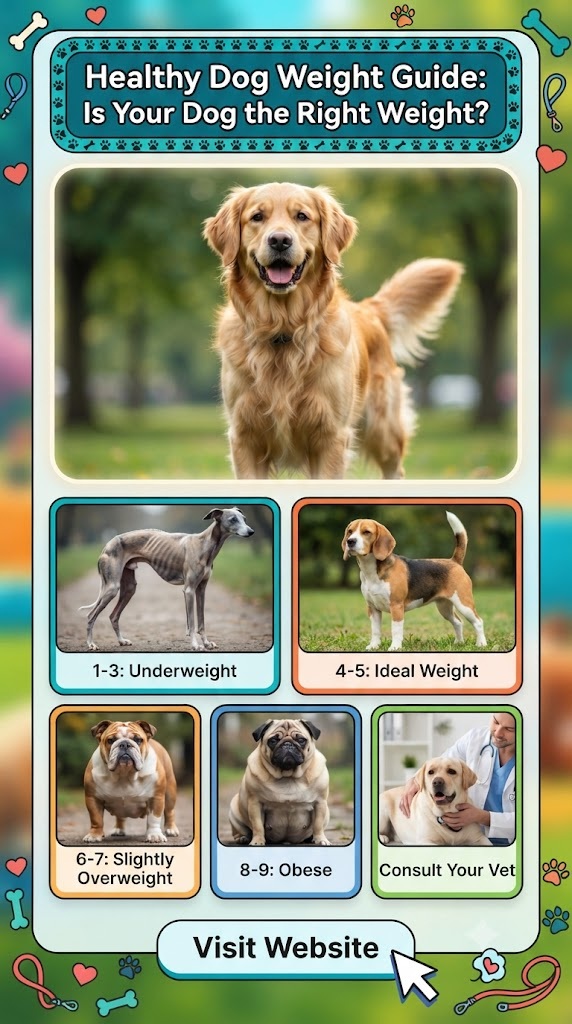
The scale is a useful tool, but the Body Condition Score (BCS) is the gold standard for assessing your dog’s weight. It is usually a scale from 1 to 9 (with 4 or 5 being ideal).
How to Perform a BCS Check at Home:
- The Rib Test: Place your hands on your dog’s ribcage. You should be able to feel the ribs easily with a slight layer of fat over them, similar to the back of your hand. If they feel like your knuckles, the dog is too thin. If they feel like your palm, the dog is overweight.
- The Waist Check: Look at your dog from above. They should have a visible “waist” indentation behind the ribs. If they look like a cylinder or a sausage, they are overweight.
- The Tummy Tuck: Look at your dog from the side. The abdomen should slope upward from the end of the ribcage to the thighs. A flat or sagging belly is a red flag.
Common Feeding Mistakes Even Pro Owners Make
1. Using a Non-Standard “Cup”
A “cup” in a recipe or on a dog food bag refers to a standard 8-ounce measuring cup. Using a random plastic stadium cup or a coffee mug can result in overfeeding by 20–50%. Use a real measuring cup or, better yet, a kitchen scale. Measuring by weight (grams) is the only way to be 100% accurate.
2. Free-Feeding (The All-Day Buffet)
Leaving food out all day is one of the easiest ways to end up with an overweight dog. It also makes it impossible to monitor if your dog’s appetite has changed—which is often the first sign of illness. Scheduled feedings (twice a day) are better for metabolism and behavior.
3. Ignoring the “Add-Ons”
That splash of chicken broth, the lick of the peanut butter jar, or the crust of your pizza… these “tiny” bites add up. If you have multiple family members, ensure everyone is on the same page regarding “extra” food.
4. Relying Solely on the Bag Instructions
As discussed, the bag is a starting point, not the law. If your dog is gaining weight on the “recommended” amount, ignore the bag and trust your dog’s body condition.
Life Stages and Feeding Schedules
Puppies (0-6 Months)
Puppies have small stomachs and high energy demands. Feed them 3 to 4 times a day. This prevents “hypoglycemia” (crashes in blood sugar) and ensures they get a steady stream of nutrients for growth.
Adults (1-7 Years)
Most adult dogs thrive on two meals a day—once in the morning and once in the evening. This helps keep their digestive system regular and prevents them from getting “hangry” in the middle of the day.
Seniors (7+ Years)
Senior dogs may benefit from smaller, more frequent meals if they have digestive issues. Because they move less, you must be extremely vigilant about weight gain. An extra two pounds on a senior dog can be the difference between them being able to stand up comfortably or suffering from debilitating joint pain.
Special Considerations: Working Dogs and Nursing Mothers
Some dogs defy the standard formulas.
- Working Dogs: A sled dog or a high-intensity hunting dog during the season may need 3 to 4 times the calories of a normal pet. These dogs require “performance” diets with high fat content, as fat is the most calorie-dense nutrient (9 calories per gram vs. 4 calories per gram for protein/carbs).
- Nursing Mothers: Producing milk is the most energy-draining activity a dog can do. A nursing dam may need to eat as much as she wants (free-feeding) and may require 2 to 4 times her normal maintenance calories.
Transitioning Foods: The Slow and Steady Approach
If you realize you’ve been feeding the wrong amount or the wrong brand, don’t change everything overnight. A sudden change in diet can cause “dietary indiscretion,” leading to diarrhea, vomiting, and a very unhappy pup.
Use the 7-Day Transition Method:
- Days 1-2: 75% old food, 25% new food.
- Days 3-4: 50% old food, 50% new food.
- Days 5-6: 25% old food, 75% new food.
- Day 7: 100% new food.
Frequently Asked Questions (FAQs)
Q: My dog acts like they are starving even after eating. Should I feed them more?
No. Some breeds (like Labs) are biologically programmed to seek food constantly. If their Body Condition Score is ideal, do not increase their food. Instead, try adding low-calorie volume, like canned green beans or plain canned pumpkin (not pie filling), to help them feel full.
Q: Is grain-free food better for weight management?
Not necessarily. Many grain-free foods replace grains with potatoes or legumes, which can actually be higher in calories and carbohydrates than grain-inclusive options. Always check the kcal/cup.
Q: Should I feed my dog wet food or dry kibble?
Wet food is typically lower in calories by volume because it is 75% water. This can be great for weight loss because the dog gets to eat a larger portion for fewer calories. However, kibble is more convenient and often better for dental health. A “topper” of wet food on kibble is often a great middle ground.
Q: Can I just feed my dog once a day?
While some dogs do fine with “Intermittent Fasting” (one meal a day), it can lead to bile vomiting (yellow foam) in some dogs if their stomach stays empty for too long. Two meals are generally recommended for stability.
The Bottom Line: Feed the Dog in Front of You
The most important takeaway is this: The scale and the measuring cup are tools, but your dog’s body is the ultimate guide.
If your dog is losing weight and looks “bony,” increase their food by 10%. If they are losing their waistline and getting “chunky,” decrease their food by 10%. Check their Body Condition Score every single month.
Feeding your dog the right amount isn’t about restriction; it’s about empowerment. When you provide the precise amount of fuel your dog needs, you are reducing their risk of disease, improving their energy levels, and giving them the best possible chance at a long, vibrant life.
Stop guessing, start calculating, and watch your dog thrive.